Two products can highlight the same ingredient while presenting very different information on their labels. A cream might list a peptide among many ingredients without stating its percentage. A dietary supplement might give an amount per serving, but group some ingredients into a blend. Comparing them requires more than finding a matching word.
This guide introduces a practical ingredient record for everyday reading. It helps you separate the product’s identity, the quantity information actually supplied and the claims that require evidence beyond the label. The examples are invented and do not describe or recommend a particular product.
First identify what kind of product you are reading
Write down whether the package describes a cosmetic, a food, a dietary supplement or something else. Keep the intended use beside that description. A name shared across categories is not a reason to treat the products as interchangeable.
For example, “collagen” on a powder and “collagen” in a topical formula may lead to different reading questions. The powder’s serving information does not explain the composition of the cream. Likewise, a cosmetic claim cannot establish a nutritional effect.
If the product category is unclear, resolve that before comparing numerical claims. A neat spreadsheet does not become meaningful when its rows describe different kinds of information.
Understand the basic label format
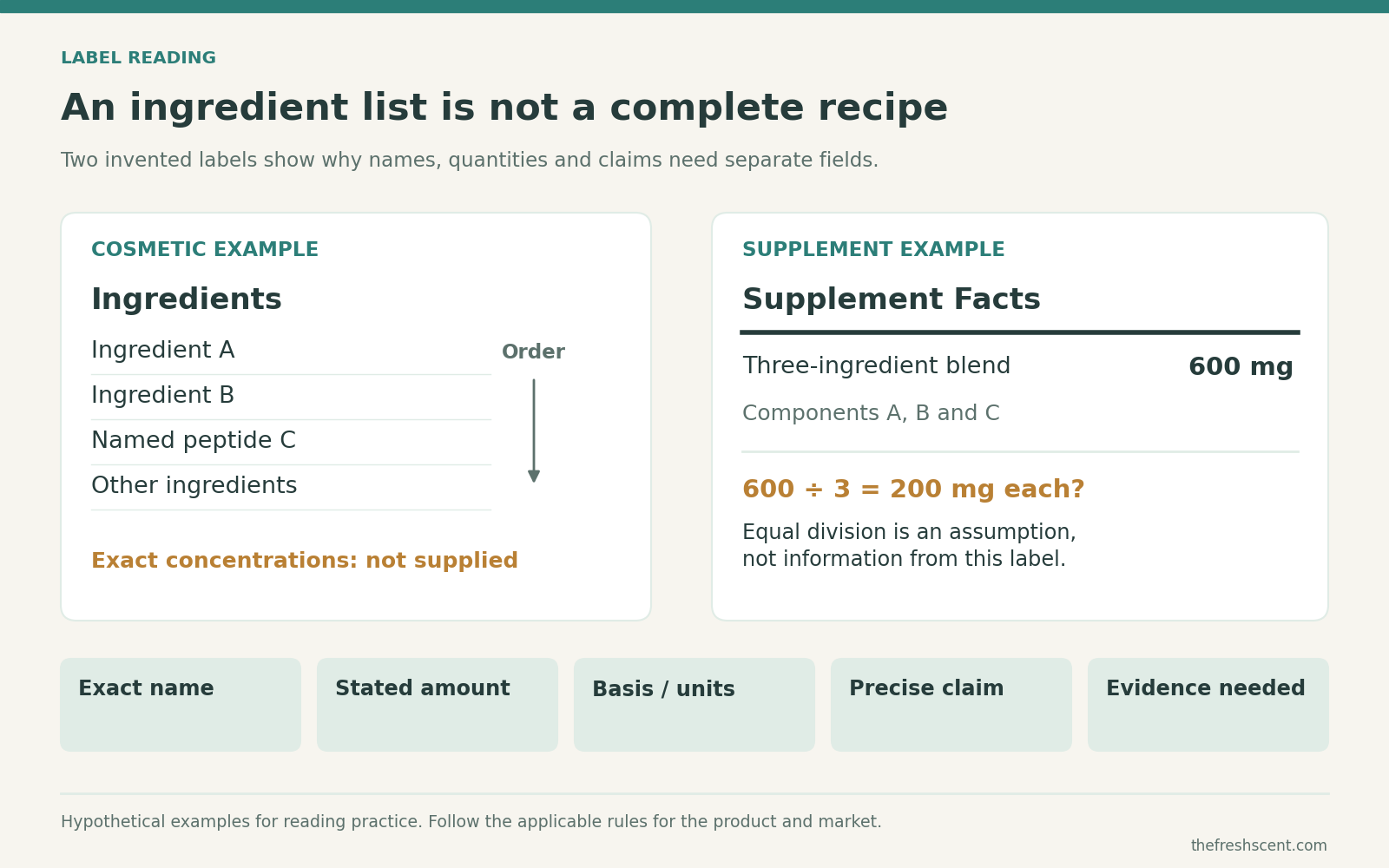
The FDA’s cosmetics labelling guide explains that US cosmetic ingredients are generally listed by predominance, with exceptions including ingredients present at one per cent or less and colour additives. The list usually does not provide exact concentrations. Its order is useful information, but it is not a recipe you can reconstruct.
The NIH Office of Dietary Supplements describes a different label structure for supplements: serving information and dietary ingredients appear in a Supplement Facts panel, with other ingredients listed separately. A proprietary blend can report a total blend weight without identifying the amount of every component.
These descriptions concern the US label frameworks. For a product sold elsewhere, check the applicable local guidance instead of assuming that every rule transfers unchanged.
Create a five-column ingredient record
| Field | What to copy | What to leave open |
|---|---|---|
| Product identity | Full name, version and intended use | Whether a similarly named product is equivalent |
| Ingredient name | The exact printed name | Unconfirmed synonyms or substitutions |
| Quantity information | Amount, units and the basis stated | Any concentration not supplied |
| Claim | The precise promised result | Whether the label alone establishes it |
| Evidence question | The document needed to assess the claim | The answer until that document is examined |
You can keep this in a notebook or a spreadsheet. The important feature is the empty space for uncertainty. If a label does not provide a number, write “not stated.” Filling the gap with an estimate creates information that the package never gave you.
Copy exact names before simplifying them
Ingredient names can be long, similar or presented alongside a trade name. Copy the full wording before assigning a short label in your notes. If you later discover that two names refer to the same ingredient, add the connection with its source.
Do not collapse several ingredients into “peptides” and then assume a study about one applies to all. A family description may help you organise a list, but it can hide the specific identity needed to check a claim.
A useful naming note has three parts: the name on the package, any alternative name you have verified and the document that connects them. That gives another reader a way to check your work.
Keep quantities attached to their basis
Suppose an invented supplement lists 600 milligrams for a three-ingredient blend. You cannot divide that total by three and assume that each ingredient contributes 200 milligrams. Equal division is a mathematical possibility, not information supplied by the label.
Now imagine a cosmetic advertisement stating “five per cent complex.” Before comparing that number with another formula, ask what “complex” includes. Does it describe a mixture supplied to the manufacturer, the named ingredient itself or a different measurement? The label or manufacturer needs to clarify the basis.
These examples do not establish that either product is misleading. They show how a percentage or total can be clear in appearance while still leaving a specific question unanswered.
Turn vague claims into answerable questions
Words such as “advanced,” “premium” and “science-led” do not tell you which result was measured. Translate the statement into a question you could ask about evidence. What changed? Compared with what? In which people or experimental system? Over what period?
For a fictional peptide cream described as “clinically inspired,” the first question is whether the company is citing a study of the finished formula, an isolated ingredient or a related concept. Each possibility gives the phrase a different meaning.
A short, precise question is more productive than asking a manufacturer whether its product is “good.” It also makes an incomplete response easier to recognise.
Separate practical suitability from benefit claims
A product can fail your practical requirements before you reach the research question. The package may contain an ingredient you have been advised to avoid, a format you do not want or insufficient information to identify it reliably.
Write these requirements separately from claims about effectiveness. For example, an unfragranced preference, a dietary restriction and a request for evidence are three different entries. Combining them into a single score can hide the reason a product does or does not fit your needs.
When a health condition, allergy or medicine affects the decision, take the complete ingredient list to the relevant clinician or pharmacist. A comparison worksheet organises information; it does not supply that personal assessment.
Save the label you actually reviewed
Keep a photograph or a saved copy of the full label, including the product version and package size. Record where and when you obtained it. If an online listing changes, your notes will still show which information supported the comparison.
Finish by marking each question as answered, partly answered or unresolved. That simple classification is more informative than treating a long ingredient list as either impressive or alarming. You will have a clear record of names, quantities and evidence gaps, ready for a more focused look at proteins, peptides or any other ingredient family.